


The true cost of an unfilled leadership role in a regulated business
An empty leadership role looks like a saving on the only report where anybody is measuring it. The salary is not being paid. The recruitment fee has not been raised. On the monthly numbers, the vacancy is a credit.We work on regulated sites across the United States, which means we arrive after the vacancy has been running for a while and we get to see what it did. Not the headline version.
The submission that quietly moved a quarter. The audit answered by somebody acting up. The deputy who covered for seven months and then resigned two weeks after the new leader arrived. Almost none of that ever gets attributed back to the empty seat, because by the time it surfaces the seat is full again.
The financial context is worth stating once, carefully, because it sets the scale of everything that follows. Research published in 2024 by the Tufts Center for the Study of Drug Development, based on 645 drugs and biologics launched since 2000, put the value of a single day of delay at approximately 500,000 dollars in unrealized prescription sales, and found the direct daily cost of running a late phase clinical trial to be roughly 40,000 dollars, rising to around 55,716 dollars per day for phase three. Those figures describe delay in general rather than delay caused by a vacancy. But they establish the exchange rate. In this sector, time converts into money at a rate that makes almost any salary look like a rounding error.
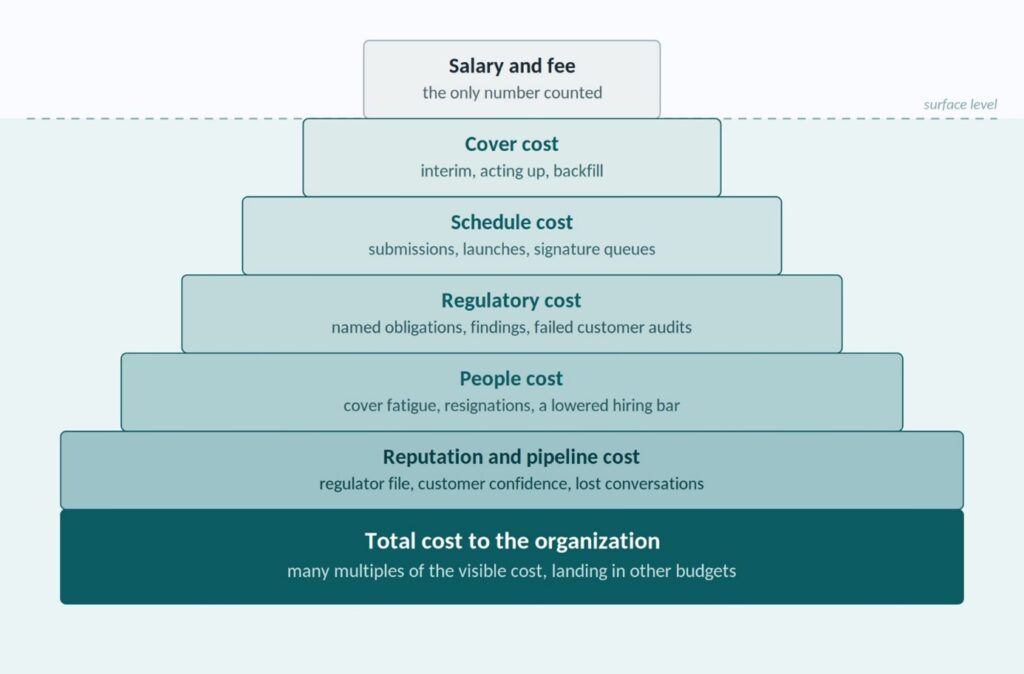
That is the argument of this piece. In a regulated business the visible cost of an unfilled leadership role is the smallest number in the calculation, and it is the only one most organizations count. What follows is where the rest of it goes.
WHAT YOU CAN SEE
The salary you are not paying is not a saving
The saving is real for exactly as long as the work is not being done, and the work is always being done. It is being done by somebody who already had a job, usually at a lower grade, usually without the authority that goes with the role, and usually without the deputy who would normally cover them.
So the first correction to the calculation is that the salary line does not disappear. It is redistributed at a worse conversion rate. A site director covering a vacant head of quality role is doing the quality work badly and the site director work not at all, and the second of those is the more expensive half.
Interim cover corrects part of this and is often the right decision, but it should be costed honestly. A capable interim in a regulated leadership role in the United States frequently costs more per week than the permanent salary you are notionally saving, and the interim will not make the decisions that carry twelve month consequences, because they are not going to be there in twelve months. That is not a criticism of interims. It is what interim cover is for, and organizations get into trouble when they buy stability and assume they have bought direction.
What the recruitment fee comparison actually hides
The fee is the number that gets scrutinized hardest, which is understandable, because it is the only one on the list that arrives as an invoice. It is also the only one on the list that is fixed, knowable in advance, and paid once.
Every other cost in this article is variable, unbounded and repeating. The comparison that matters is not fee against salary. It is fee against the cost of another month of the role being empty, and then another. Once a business runs that comparison properly it usually finds that the expensive decision was not the fee. It was the four months spent deciding whether to pay it.
WHAT IT COSTS ON THE CALENDAR
What happens to a submission when the person who owns it leaves
Regulatory submissions do not stall because nobody can write them. They stall because a submission is a series of judgment calls about what to include, how to characterize a deviation, which data set answers a question the agency has not asked yet, and when the package is genuinely ready rather than merely complete.
Those calls get made confidently by somebody who has made them before and who will still be there when the agency responds. They get deferred by somebody covering. Deferral looks like extra review cycles, a decision to wait for one more batch of stability data, a preference to hold the filing until the permanent leader is in post so that the person who owns the answer is the person who signs the question. Each of those is individually defensible. Together they are how a submission moves a quarter to the right without anybody deciding to move it.
The same mechanism applies to launch readiness. A launch date is held in place by dozens of small commitments made in advance by people with the standing to make them. Remove one of those people and the date does not collapse. It softens, and softening is much harder to escalate than failure.
Where the production bottleneck actually forms
The intuitive model of a production bottleneck is a capacity problem. In a regulated environment during a leadership vacancy it is almost always a signature problem.
Batch release, deviation closure, change control approval, validation protocol sign off, supplier qualification and specification changes all sit with named approvers. When one of those approvers is absent, the work does not stop. It queues. And because a queue is not an incident, nobody raises it. The site continues to hit its production numbers for a while by drawing down on the buffer of decisions the previous leader had already made.
The bottleneck becomes visible one to two quarters later, when that buffer runs out. By then the causes look operational rather than organizational, and the fix is scoped as a process improvement project rather than as a hire. This is the single most common reason we see boards underestimate the cost of a vacancy. The pain arrives far enough after the cause that the two are never connected.
The decisions that simply do not get made
Capital projects, remediation programs, site expansions, technology transfers and second source qualifications all need somebody willing to commit to a plan that outlasts their tenure. Nobody covering a role commits to that, and they should not be asked to.
The cost here is not a delay you can point at. It is a year in which the organization did nothing structurally significant, discovered afterward that it had lost ground to a competitor who did, and had no line item to explain it. Of all the costs in this article this is the largest and the least recoverable, and it is invisible by construction, because the cost of a decision not taken never appears anywhere.
WHAT IT COSTS ON THE LICENSE
Which obligations are attached to a person rather than a process
Most of what a leadership role carries in a regulated business sits with the process. A part of it sits with the named individual, and that part does not wait for your search.
Device establishment registration requires an official correspondent to be designated for each establishment as the point of contact with the agency, and changes to registration information carry a notification obligation. Foreign establishments importing into the United States must designate a single United States agent. Current good manufacturing practice requires a quality control unit with defined authority, staffed by an adequate number of people with the education, training and experience to do the work, which is a standard an inspector can and does test against a depleted organization chart. Sites also carry named individuals on state licenses, controlled substance registrations, clinical trial registrations and customer quality agreements, and those obligations vary by state, by product and by contract.
The consequence is that a business can be compliant on paper the day a leader resigns and non compliant a few weeks later without having changed a single procedure. Nobody owns finding these, because they sit across regulatory affairs, legal and the contracts folder.
Build the register before you need it. One list of every external obligation that names an individual, with the notification deadline against each. It costs a few days of somebody’s time and no hiring at all, and it turns the most alarming category of vacancy risk into an administrative task.
What an inspector sees two quarters later
An inspection does not assess your leadership structure. It assesses your records, and the records of a site that has been without a functioning quality or technical leader for two quarters have a signature. Deviation closure times lengthen. Corrective and preventive action commitments pass their due dates and get extended. Investigations close to a root cause of human error more often, because the person with the authority to insist on a harder answer is not in the room.
None of these is fatal on its own. Collectively they read as a quality system that is not under control, which moves the conversation from the specifics to whether management oversight is adequate. A business that would have taken a handful of observations takes something considerably worse, and the vacancy that caused it ended months before the investigator arrived.
The customer audit you cannot reschedule
For contract development and manufacturing organizations, contract research organizations and anybody selling capacity or capability, the customer audit is where a vacancy converts most directly into lost revenue. A prospective customer sending a team to site is assessing whether your organization can carry their program for the next several years, and the fastest read available to them is who is in the room and how they answer. An acting head of quality who prefixes answers with a note that they are covering the role has told the auditor everything, and in a competitive tender that is a straightforward reason to prefer the other bidder.
Existing customers apply the same logic through a different door. Many quality agreements carry notification obligations covering changes in key personnel, and a customer who learns the role is vacant will increase audit frequency, ask for more data and become slower to award new programs. None of that appears as a cost. It appears as a pipeline that stopped converting.
WHAT IT COSTS IN THE BUILDING
The deputy who covers is usually the person you least want to lose
The person who steps up is almost always your strongest internal candidate for the role or the one after it. Covering is presented to them as an opportunity, and for the first two months it is.
After that it becomes a job with the accountability of the senior role, the authority of their existing one and none of the compensation of either. They are exposed to the regulator, the customer and the board without the standing to push back. If the search then appoints externally, that person has spent half a year proving they could do the job and been told they could not have it, and no amount of careful communication fully removes the sting.
This is the most predictable resignation in the sector, and it usually lands within a few months of the new leader starting, which is exactly when the new leader most needs institutional memory. The vacancy therefore has a habit of producing a second vacancy at the worst possible moment.
Almost all of this is fixable without hiring anybody. Appoint the acting person formally rather than informally. Pay for the acting period. Tell them honestly and early whether they are a candidate. If they are not, say so, explain what would make them one and give them something to hold that outlasts the search. If they are, put them through the same process as the external field so the outcome is defensible either way.
What the wider team hears when a leadership role stays open
The team draws two conclusions from a long vacancy, and both are corrosive.
The first is that the role does not matter very much, because an organization that needed it would have filled it. In a quality or regulatory function this belief does measurable damage, since the whole point of the function is that it is taken seriously when it is inconvenient.
The second is that the person eventually appointed is an unknown quantity who will arrive with an agenda. Uncertainty about a new leader is normal and manageable over a few weeks. Sustained over six months it stops being uncertainty and becomes planning. People update their profiles. They take the recruiter call they would normally decline. Your competitors, who can see the vacancy on your careers page, know precisely when to make those calls.
Say publicly what the timetable is, and say what happens if it slips. A team told that the search will take five months and that they will hear at the end of each month is far more stable than a team told nothing, even when the underlying facts are identical.
Why the hiring bar drops at about month seven
This is where a vacancy converts into the more expensive failure. Pressure accumulates, the organization becomes tired of the process, and the requirement quietly changes from finding the right person to ending the situation.
The signs are consistent. The specification gets softened to fit the strongest available candidate rather than the need. Reference checking becomes lighter because nobody wants to find something. Concerns raised at interview get recorded as development areas. The compensation debate that stalled the search for a quarter gets settled in an afternoon.
The appointment made under those conditions has poor odds, and when it fails at month fourteen the organization does not restart from where it began. It restarts from a worse position, with a demoralized function, a skeptical board, a customer base that has now seen two changes and a market that has noticed. This is the mechanism by which a vacancy stops being an expensive
inconvenience and becomes a strategic setback, and it is the most avoidable failure described anywhere in this article.
WHAT IT COSTS OUTSIDE THE BUILDING
What a regulated business’s reputation is actually made of
Reputation with a regulator is not a feeling. It is a file. Inspection history, response quality, commitment dates and whether previous commitments were met. Enforcement correspondence is published on the agency website and stays there, which means the file is not internal to the relationship. It is a permanent, public, searchable record that anybody assessing your business can consult before they speak to you.
A period of weak oversight during a vacancy writes into that file, and the file is what determines the posture of the next inspection. This is the cost with the longest tail of anything in this article. It can take years to work off, it prices into due diligence during a transaction and it is entirely invisible on any internal report.
Reputation with customers works the same way through a different channel. In a market where technical leaders move between a relatively small number of employers, the fact that your site has been without a head of function for eight months is not confidential information. It is known.
The commercial conversation you stop being invited to
The last cost is the hardest to evidence and one of the largest. Senior technical and quality leaders are commercial assets. They are the reason a partner brings you an early stage conversation rather than a request for quotation, the reason a customer asks whether you could take a second program, the reason a scientific advisory relationship exists at all.
When the seat is empty those conversations do not get redirected. They stop happening, because the relationship sat with a person and nobody outside your organization is tracking who inherited it. You will not know what you lost, which is precisely why this cost never makes it into the business case for the hire.
THE COMMON THREAD
Every cost in this article behaves the same way. It appears somewhere other than the vacancy, later than the vacancy, and in a currency that does not obviously connect back to it. Delay lands in commercial. Signature queues land in operations. Findings land in quality. Resignations land in human resources. Lost conversations land nowhere at all.
Only one of these costs lands where the decision is made, and it is the salary you are not paying, which is a credit. That is the whole problem. The organization is running a calculation in which the single number visible to the decision maker points in the opposite direction to every other number in the system.
The correction is not to hire faster. It is to make the full number visible before the search starts, so that the timetable, the compensation range and the amount of senior attention given to the process are all set against the real cost of the role being empty rather than against the fee. Businesses that do this run shorter searches, pay closer to market first time and appoint people who last. Businesses that do not spend a year saving a salary and considerably longer paying for it.
If you have a leadership role open now, or one you know is coming, the useful first step is unglamorous. Write down what the role decides, what it signs, what it is named on and who it talks to outside the business. That single page is your cost of vacancy, and it is almost always a bigger number than anybody expected.


Related Posts

Why Senior Pharmaceutical Hires Often Fail
A meaningful proportion of the searches we are asked to run in this sector are second attempts. Either the first appoint…